Small-pot rotation turntable.
200 mm lift-off rotating platform centered on a printed journal and supported by three purchased PTFE glides.
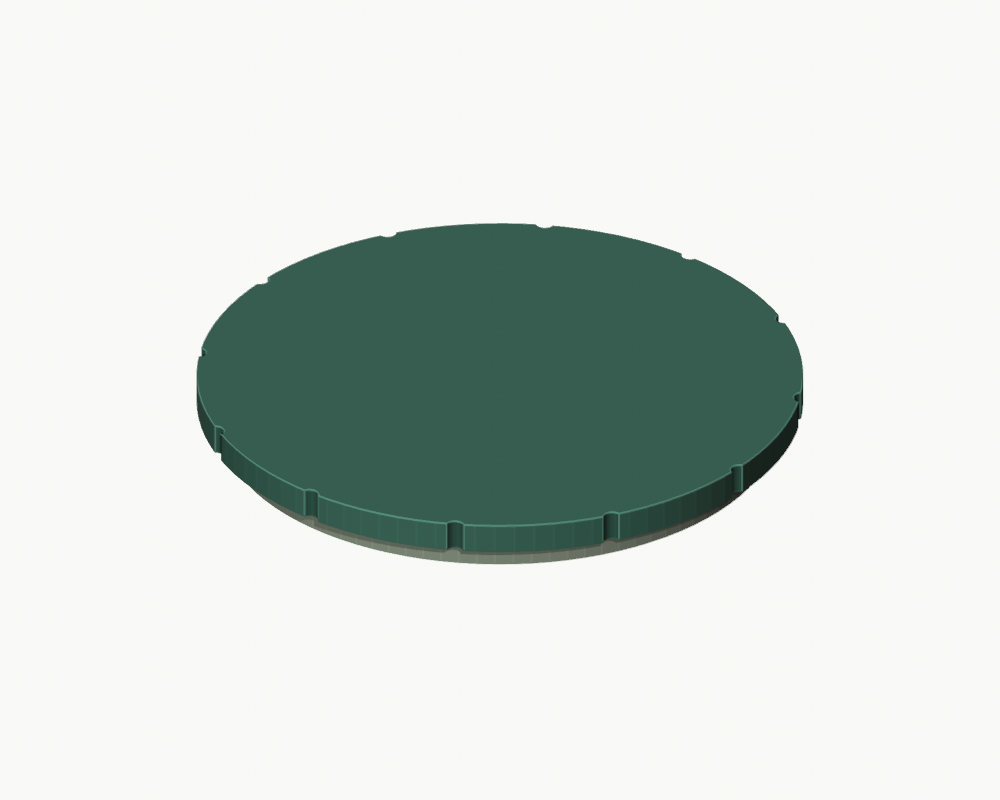
INTERACTIVE 3D PREVIEW
See it from every angle.
Loading 3D preview…
Drag to rotate · Scroll to zoomPLANT WORKSHOP / PROTOTYPE
Make and assemble.
All dimensions are in millimeters. These designs have passed digital mesh checks but have not been physically printed or tested. Check fit, water resistance, and load capacity for your setup.
Parts to print
- base × 1184 mm diameter, 8 mm thick with a 20 x 6 mm journal.
- platform × 1200 mm diameter, 10 mm thick; socket faces up during printing and down during use.
Additional components
- 3 x matching, noncompressible PTFE furniture glide disks, nominal 20 mm diameter x 2 mm total installed thickness, including adhesive backing.
- Optional thin nonslip pads underneath the base; keep all pads the same thickness.
- Optional thin rubber mat between pot and platform, trimmed clear of the platform edge.
Assembly
- Remove burrs from the 20 mm journal and 20.8 mm socket. Confirm the platform slips over the journal without forcing it.
- Clean the three shallow 20.6 mm pad recesses. Install one 20 mm PTFE glide in each, with the sliding faces upward.
- Turn the platform so its blind socket faces down and lower it over the journal.
- Rotate the empty platform through a full turn. All three pads must contact; the journal must not bottom out in the socket.
- Place a small pot centrally, start with a light empty pot, and verify smooth motion and base stability before adding soil or water.
- Lift the platform vertically to clean; the top is intentionally removable and has no retention clip.
Print notes
- PETG suggested; start with 0.20 mm layers, 4 walls, 30% infill and at least 5 top/bottom layers.
- Print base flat. The platform STL is deliberately upside down: broad smooth top face on bed, blind socket open upward.
- No assembly supports are needed in the nominal geometry. Add a brim only if your slicer/material needs it.
- Keep the top of each glide and the underside running track clean. Do not lubricate with substances that could attack the plastic or contaminate the plants.
Limitations
- PROTOTYPE / NOT PHYSICALLY TESTED.
- No load rating; start with small, light pots. This prototype does not establish suitability for heavy containers.
- The lift-off platform is centered but not captive. Lift the assembly by its base, not its top.
- With exactly 2 mm installed glides in 0.8 mm recesses, disk separation is 1.2 mm and journal engagement is 4.8 mm. Socket depth is 5.8 mm, leaving 1 mm nominal axial clearance.
- Pad thickness must be measured under light compression. Thin pads can cause the journal to bottom out; thick pads reduce journal engagement.
- A pot base around 140 mm diameter or smaller gives a practical starting footprint; stability still depends on pot height and mass.